General and Medical Chemistry Lab 7: electrochemical methods
A student's answers to the lab's questions on electrolytes, conductometry and the potentiometric titration of phosphoric acid, typed and checked. The curve below is computed for 0.1 M solutions, not measured.
Electrolytes and dissociation
- Electrolytic dissociation: an electrolyte splits into ions in water, for example NaCl → Na⁺ + Cl⁻.
- Electrolyte: a substance that conducts in solution or when molten, because it forms ions.
- Strong electrolytes dissociate almost completely (HCl, NaOH, NaCl); weak ones only partly (CH₃COOH, NH₃).
- Degree of dissociation: α = dissociated molecules ÷ all the molecules dissolved.
- Equilibrium constant: describes the balance between reactants and products. For an acid, HA ⇌ H⁺ + A⁻, the acid dissociation constant is Ka = [H⁺][A⁻] ÷ [HA]; the larger Ka, the stronger the acid.
- Pure sucrose does not conduct: it dissolves as whole molecules and forms no ions.
Conductometry: the ash content of sugar
- Conductivity is a solution's ability to conduct electric current. Conductance G = 1/R, in siemens (S).
- G = κ × A ÷ l: κ is the specific conductivity in S/m (the conductance between electrodes of 1 m² placed 1 m apart), A the electrode area and l the distance between the electrodes.
- The cell constant depends on the electrode area and their distance. It is found with a KCl solution of known κ: K = κ(KCl) ÷ G(KCl). Any measured conductance then gives κ = K × G.
- The sugar solution gives κc = K × Gc; the water used gives κw = K × Gw. The salts alone give κs = κc − κw.
- Ash content is the mineral salts (impurities) in sugar. Since sucrose adds no ions, the salts' conductivity measures them.
- The notes write λ for the measured conductance; it is written G here.
Potentiometric titration of phosphoric acid
- In a potentiometric titration a pH meter follows the pH as the titrant goes in. The equivalence point, where chemically equivalent amounts of acid and base have reacted, is the curve's inflection point, where the pH changes fastest.
- Phosphoric acid gives up its protons in three steps:
- H₃PO₄ ⇌ H₂PO₄⁻ + H⁺ (pKa1 about 2.1);
- H₂PO₄⁻ ⇌ HPO₄²⁻ + H⁺ (pKa2 about 7.2);
- HPO₄²⁻ ⇌ PO₄³⁻ + H⁺ (pKa3 about 12.3).
- Titrated with NaOH it shows two steps: at NaH₂PO₄ (about pH 4.7) and at Na₂HPO₄ (about pH 9.7). The third proton is too weak to give a step in water.
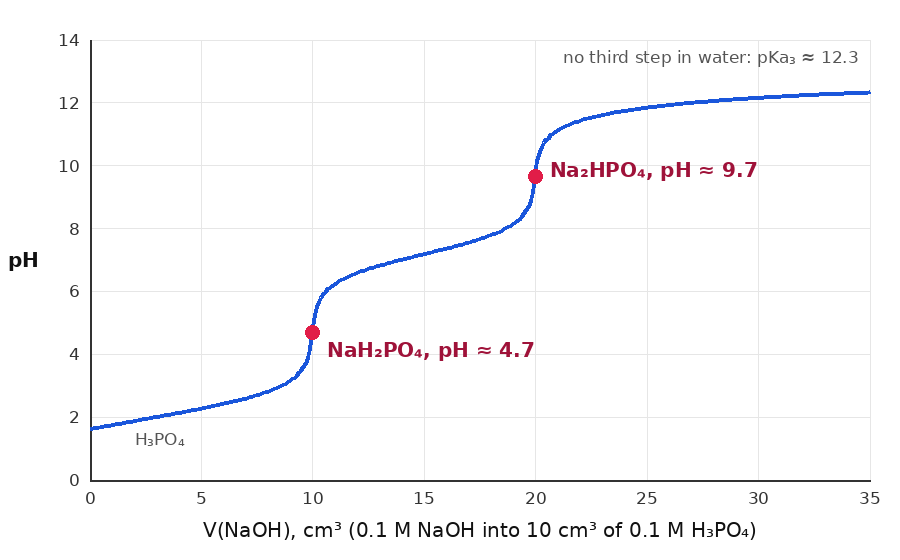
- To the second step: H₃PO₄ + 2NaOH → Na₂HPO₄ + 2H₂O, so n(H₃PO₄) = c(NaOH) × V(NaOH) ÷ 2, and m = n × M with M(H₃PO₄) = 98 g/mol.
- The concentration in the sample: X = m × 1000 ÷ V, in mg/dm³, with m in grams and the sample volume V in dm³.