General and Medical Chemistry Lab 3: solutions
Preparation for Exercise 3 of the lab manual: the calculations for every solution you make, what you will see, the report's questions answered, and the issues to be prepared. The class problem sheet follows at the end.
Issues to be prepared
Concentrations.
| Measure | Formula | Unit |
|---|---|---|
| Percentage (mass) concentration, Cp | m(solute) ÷ m(solution) × 100% | % (g per 100 g of solution) |
| Molar concentration, c | n(solute) ÷ V(solution) | mol/dm³ (M) |
| Mass concentration, γ (ρ*) | m(solute) ÷ V(solution) | g/dm³, mg/cm³ |
- The solution is the solute plus the solvent: m(solution) = m(solute) + m(solvent).
- n = m ÷ M, with M the molar mass (g/mol).
Converting concentrations. With d the solution's density in g/cm³:
- c = 10 × d × Cp ÷ M and Cp = c × M ÷ (10 × d).
- Where the 10 comes from: 1 dm³ of solution weighs 1000 × d g, of which Cp/100 is solute, so n = 1000 × d × Cp ÷ (100 × M).
- Mass concentration from molar: γ = c × M (g/dm³).
- Dilution: c₁V₁ = c₂V₂. The moles of solute do not change, only the volume.
Fractions. Each is a ratio without units (multiply by 100 for %).
- Mass fraction: w = m(component) ÷ m(mixture).
- Mole fraction: x = n(component) ÷ Σn. All the mole fractions add up to 1.
- Volume fraction: φ = V(component) ÷ V(mixture), used for liquids and gases. 70% ethanol is a volume fraction.
Density (specific mass), d = m ÷ V.
- Liquids: g/cm³. Water is about 1.00 g/cm³; it falls slightly with temperature.
- Solids: g/cm³. NaCl is 2.17 g/cm³.
- Gases: g/dm³. Air is about 1.29 g/dm³ at 0 °C.
- A solution's density rises with its concentration (for salts and acids). This is why a hydrometer can read concentration.
Measuring vessels.
- Volumetric flask: holds ("to contain", TC/In) one exact volume at 20 °C, filled to the mark. Used to prepare solutions of exact concentration.
- Measuring cylinder: an approximate volume, for when accuracy is not needed.
- Pipettes:
- A volumetric (bulb) pipette delivers ("to deliver", TD/Ex) one exact volume. A graduated pipette delivers measured volumes.
- Automatic pipettes are set to the volume needed.
- The liquid is never sucked up by mouth.
- Burette: a graduated tube with a tap, read to 0.05 cm³, for titrations (Lab 6).
- Reading volumes: read at the bottom of the meniscus, with the eye level with the mark.
Concepts.
- Dilute solution: little solute in a lot of solvent. A concentrated solution has much more.
- Saturated solution: holds the most solute that can dissolve at that temperature. It is in equilibrium with undissolved solid.
- Unsaturated solution: can dissolve more solute.
- Supersaturated solution: holds more than the saturated amount. It is unstable (metastable) and crystallises when given a nucleus (see 3.4).
- Dissolving: the solute's particles separate and are surrounded by solvent molecules (solvation; hydration in water). It can take in heat (endothermic, as for NH₄NO₃) or give it out (exothermic, as for NaOH or concentrated H₂SO₄).
- Solubility: the mass of solute that saturates 100 g of solvent at a given temperature.
3.1 10% NaCl and its density
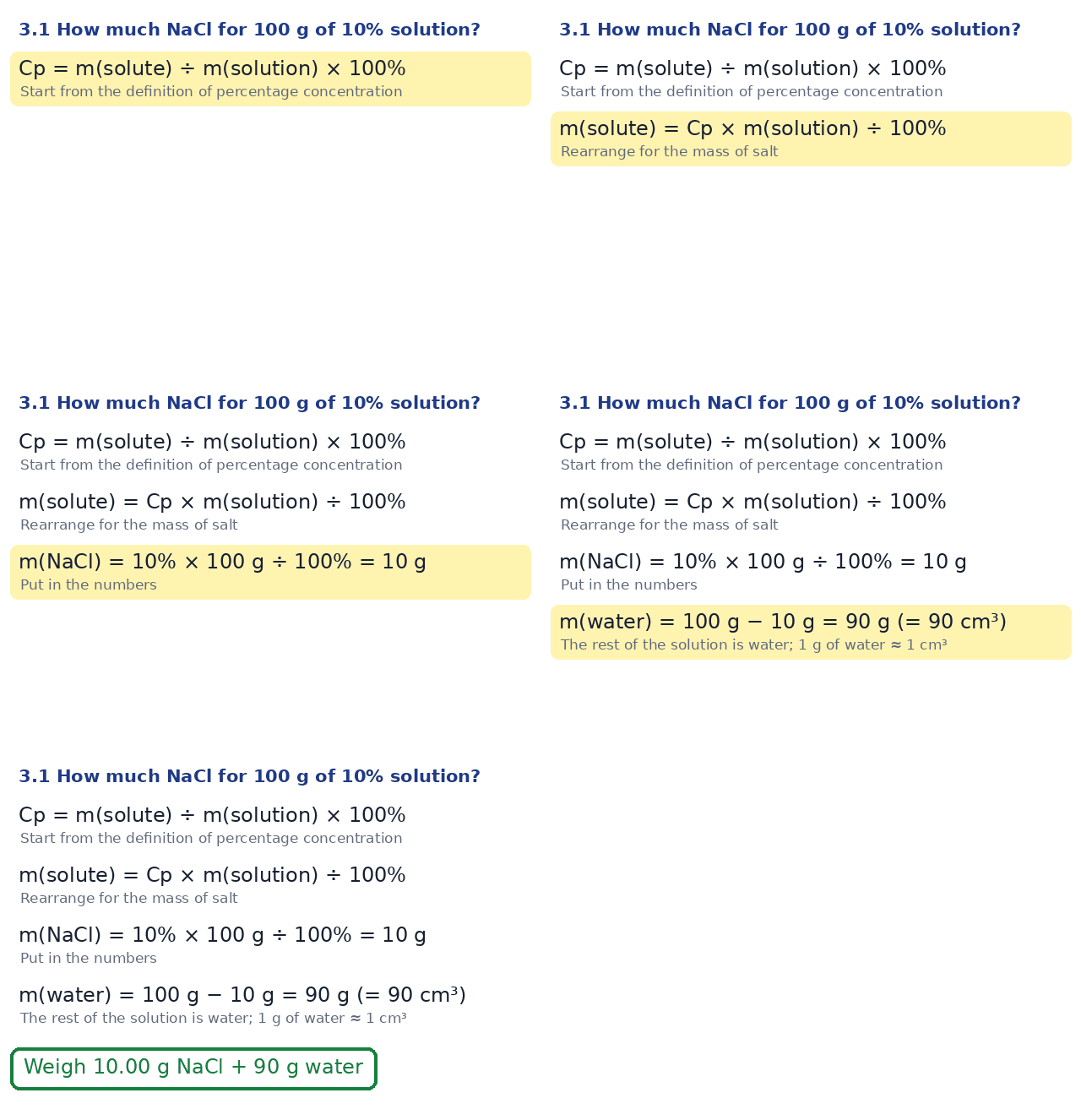
The calculation. 100 g of 10% solution = 10 g of NaCl + 90 g of water.
- m(NaCl) = 100 g × 10% = 10 g.
- 90 g of water = 90 cm³.
Doing it. Weigh 10.00 g of NaCl and transfer it to the 100 cm³ volumetric flask. Add about 50 cm³ of water and mix until it dissolves, then fill to the mark.
- Filling to the mark makes 100 cm³ of solution, not 100 g. That is 10 g per 100 cm³, slightly more than 10% by mass.
- If the class uses the 100 g recipe (10 g + 90 g of water), use that. Either way, say which in the report.
Measuring the density.
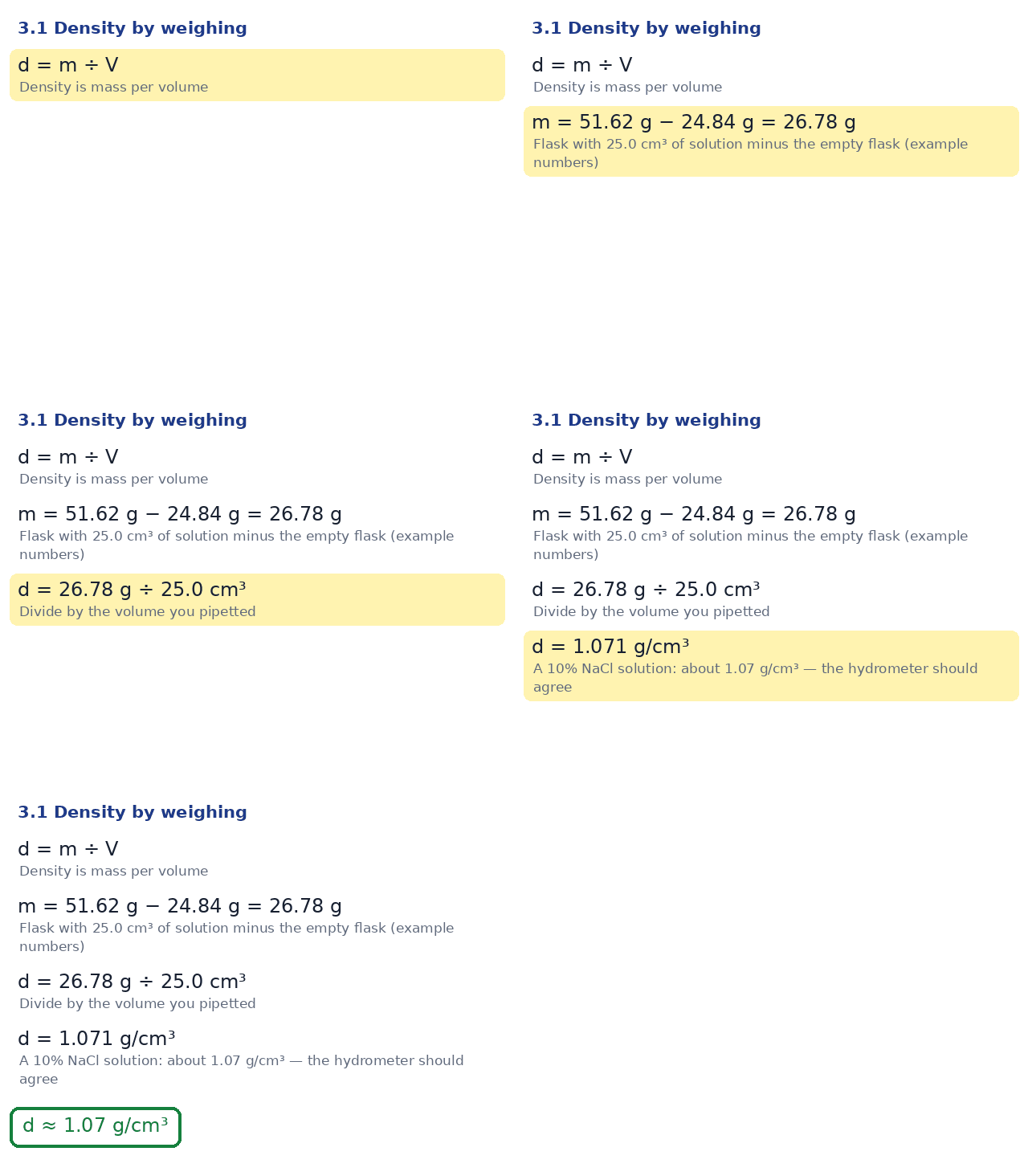
- Hydrometer: float it in the solution in a cylinder, and read the scale at the surface of the liquid. It floats higher in a denser liquid. A 10% NaCl solution reads about 1.07 g/cm³ (1.071 at 20 °C).
- By weighing: weigh an empty dry flask or cylinder, add an exact volume of the solution (e.g. 25.0 cm³ with a pipette), and weigh again. d = m ÷ V.
- Example: 26.78 g ÷ 25.0 cm³ = 1.071 g/cm³.
- The two methods should agree to about 0.01 g/cm³.
The report question: the molar concentration of the solution, knowing its density.
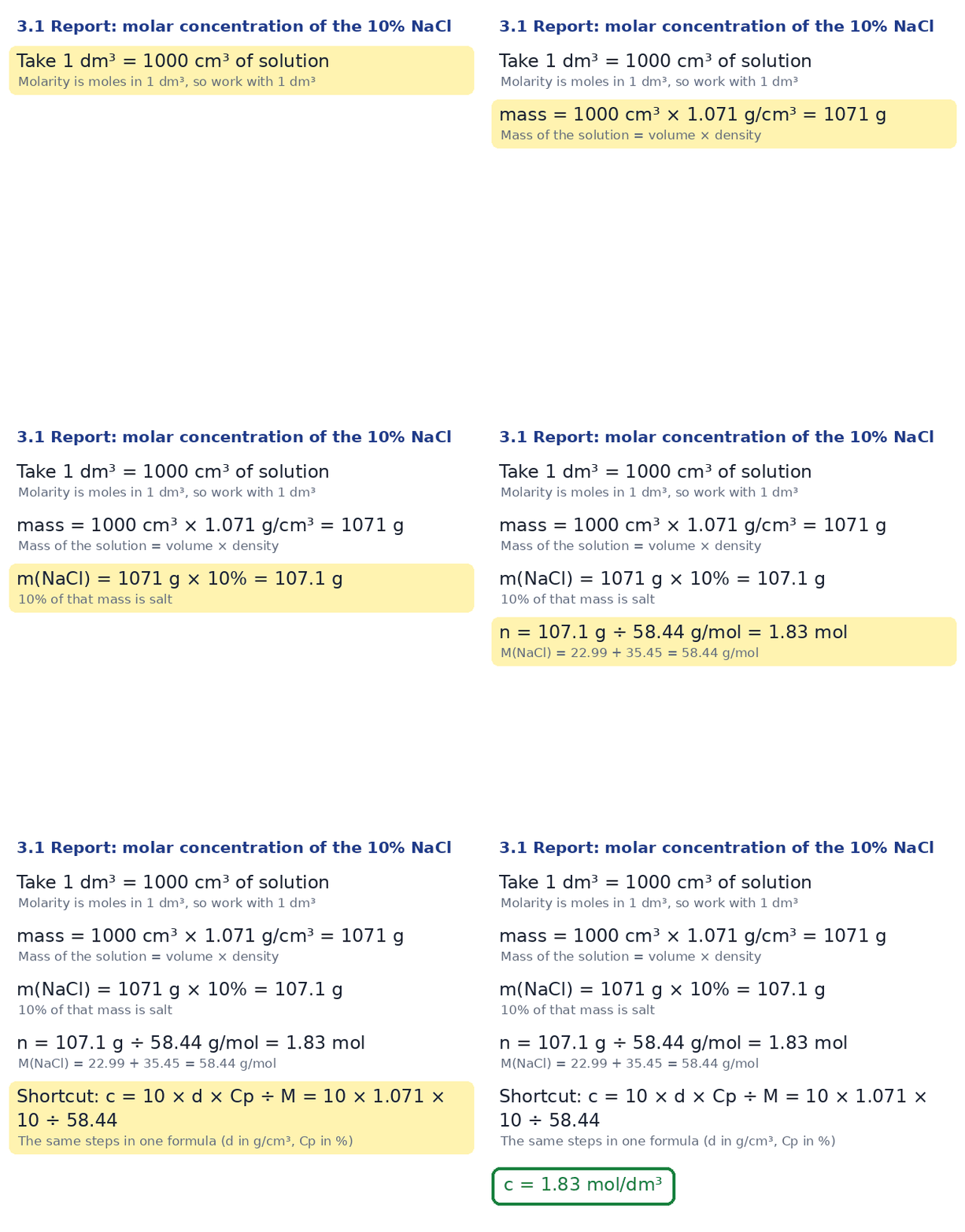
- c = 10 × d × Cp ÷ M = 10 × 1.071 × 10 ÷ 58.44 = 1.83 mol/dm³.
- Check the reasoning: 1 dm³ weighs 1071 g, of which 10% is NaCl = 107.1 g. 107.1 g ÷ 58.44 g/mol = 1.83 mol.
- If the flask was filled to the mark (10 g in 100 cm³): c = (10 ÷ 58.44) mol ÷ 0.100 dm³ = 1.71 mol/dm³. Then its true Cp = 1.71 × 58.44 ÷ (10 × 1.065) ≈ 9.4%.
- Conclusion: use your own measured density; the result is about 1.8 mol/dm³.
3.2 0.1 M HCl
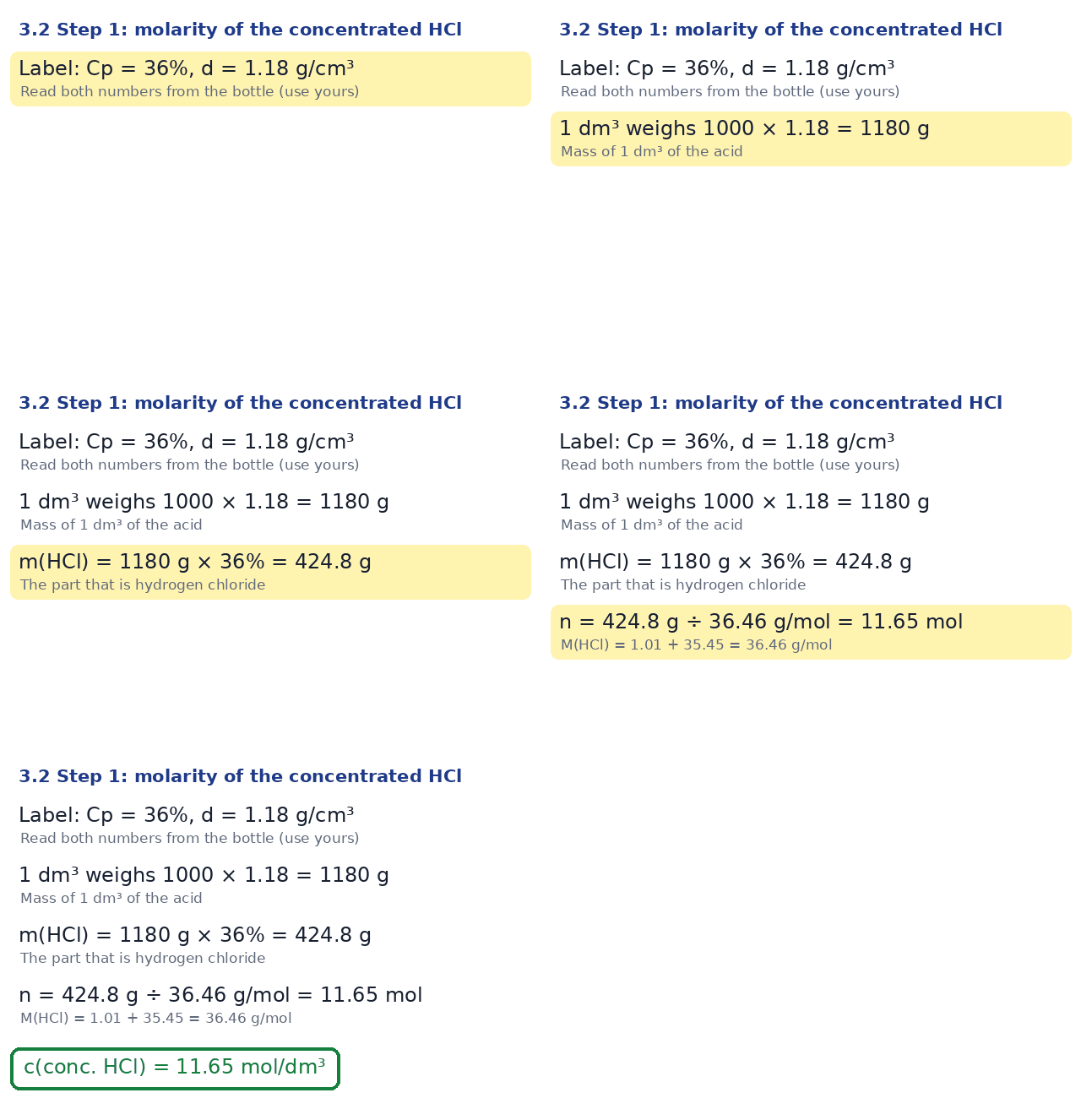
Step 1, the concentrated acid's molarity. Read Cp and d on the bottle's label. Concentrated HCl is usually 36%, d = 1.18 g/cm³.
- c = 10 × 1.18 × 36 ÷ 36.46 = 11.65 mol/dm³ (about 11.6–12 M).
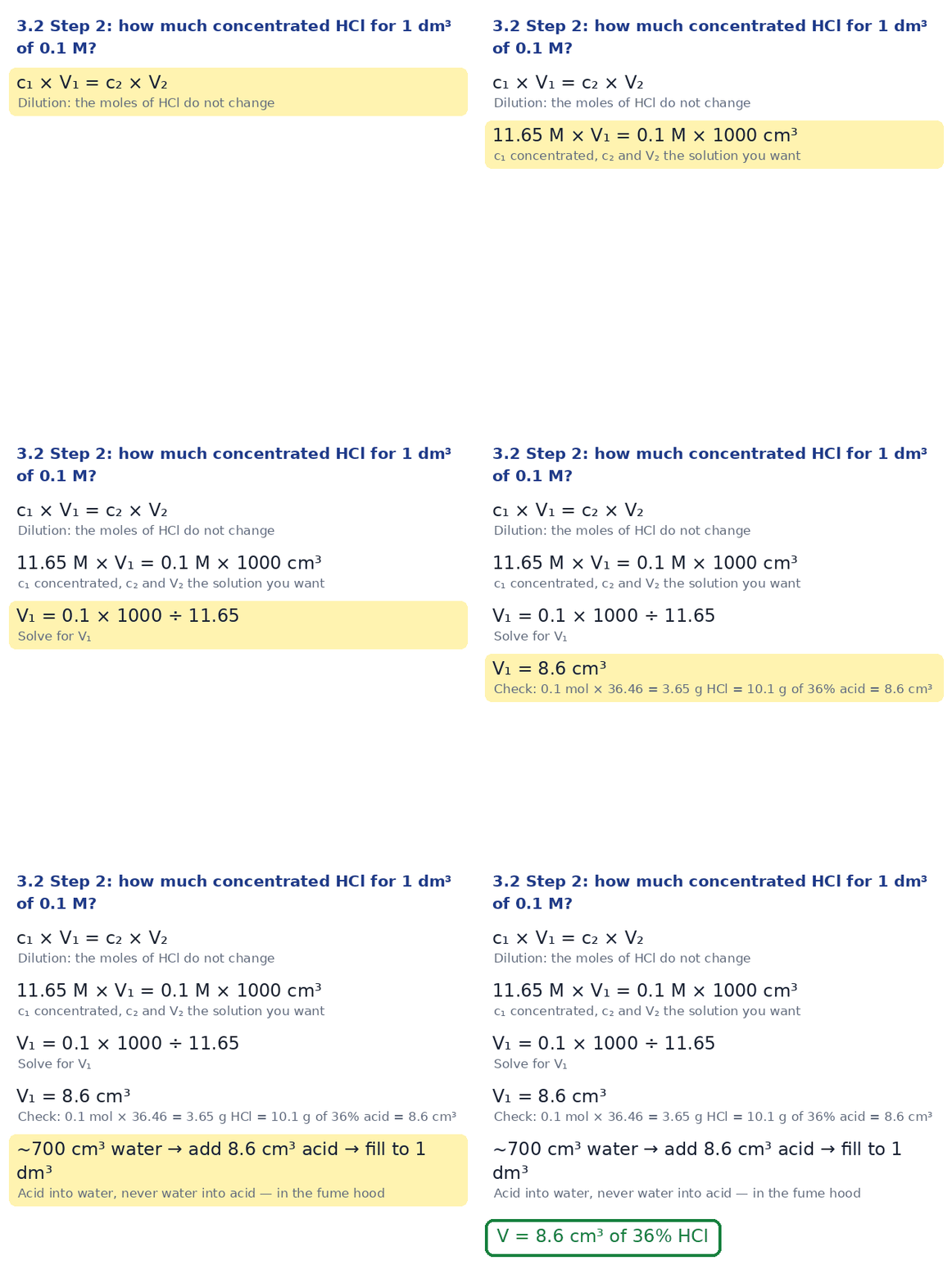
Step 2, the volume for 1 dm³ of 0.1 M (dilution, c₁V₁ = c₂V₂).
- V₁ = 0.1 M × 1000 cm³ ÷ 11.65 M = 8.6 cm³ of concentrated HCl.
- Check: 0.1 mol of HCl = 3.646 g of HCl. That is in 3.646 ÷ 0.36 = 10.13 g of the 36% acid, and 10.13 g ÷ 1.18 g/cm³ = 8.6 cm³.
- With a 37% acid of d = 1.19, c = 12.1 M and V = 8.3 cm³. Use the values on your bottle's label.
Doing it (in the fume hood). Put about 700 cm³ of water in the 1 dm³ flask, then add the acid to the water, never water to the acid. Mix, then fill to the mark.
- Why the acid goes in last: dilution gives out heat. Acid poured into a lot of water warms it a little, but water added to acid can boil locally and spit.
- Concentrated HCl fumes: its HCl gas escapes. That is why the hood is needed.
Conclusion: the solution is about 0.1 M. Its exact concentration is found by titration against sodium carbonate in Lab 6.
3.3 0.1 M NaOH
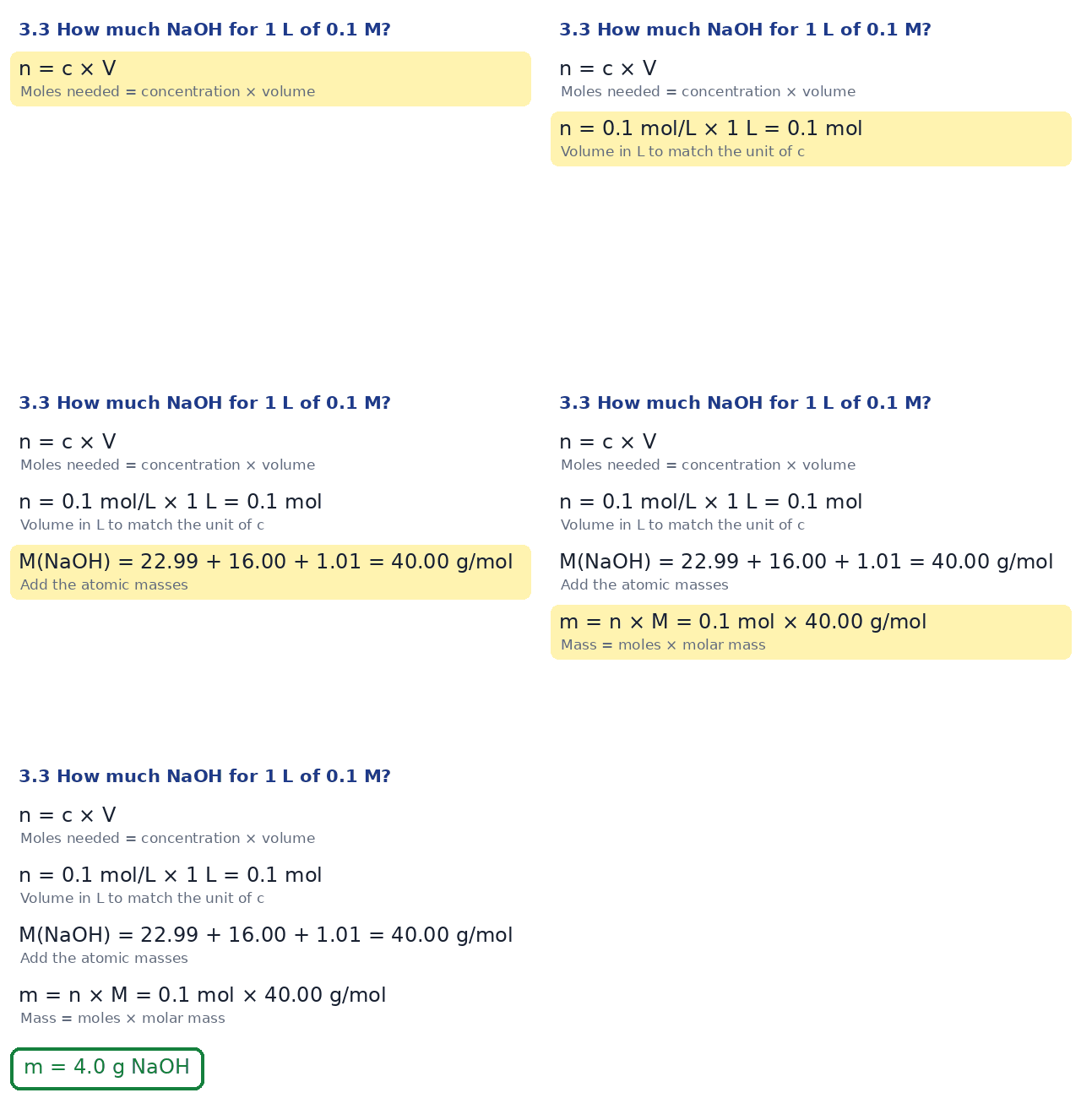
The calculation. n = c × V = 0.1 mol/dm³ × 1 dm³ = 0.1 mol, and m = n × M = 0.1 × 40.00 = 4.0 g of NaOH.
Doing it. Weigh 4.0 g quickly, in a beaker, not on paper. Dissolve it in about 700 cm³ of water in the 1 dm³ flask, cool, then fill to the mark.
- Weigh quickly because NaOH is hygroscopic: it takes up water from the air.
- Dissolving it is exothermic, so the flask warms. Fill to the mark only when it has cooled, because the volume is calibrated at 20 °C.
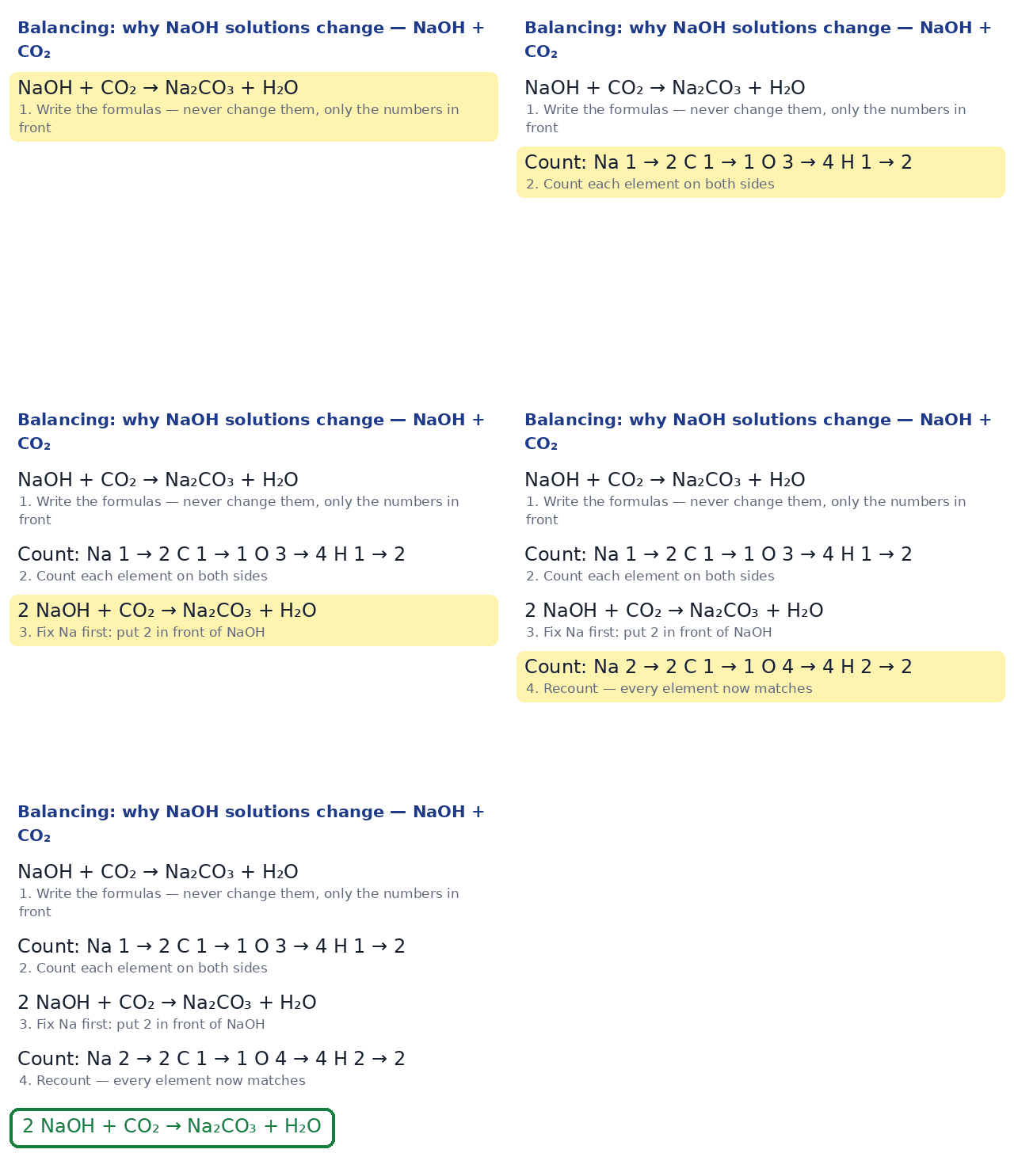
- NaOH also absorbs CO₂ (2 NaOH + CO₂ → Na₂CO₃ + H₂O).
Conclusion: for both reasons the solution is only approximately 0.1 M. It is standardised against the HCl in Lab 6. NaOH is not a primary standard.
3.4 A supersaturated solution
What happens.
- 2 g of sodium acetate dissolves in 1.5 cm³ of water only when hot, because its solubility rises steeply with temperature.
- Cooled, it stays liquid, holding far more acetate than a saturated solution can at room temperature: it is supersaturated (metastable).
- Tube 1, with a seed crystal: crystals grow at once from the crystal outward, spreading through the whole tube in seconds. The tube warms noticeably, because crystallisation gives out heat (this is how reusable hand warmers work). The tube ends up solid.
- Tube 2, rubbed with a glass rod: crystallisation starts at the scratched spot on the glass and then spreads the same way, perhaps after a short delay.
- Tube 3, untouched: stays a clear liquid. It may crystallise later on its own: from dust, shaking or a scratch.
The report question: the role of the crystal and the rubbing. Both give nucleation centres.
- A supersaturated solution cannot easily start a crystal on its own, because forming the first tiny nucleus needs energy.
- A seed crystal is a ready-made lattice the ions can add to.
- Rubbing makes microscopic scratches and glass fragments, plus local pressure and energy, where the first crystals can form.
- Once nucleation starts, the excess solute crystallises until the solution is just saturated.
Conclusion: a supersaturated solution is thermodynamically unstable. A nucleus (seed crystal, scratch or dust) releases the excess solute as crystals, with heat given out.
Balancing the equations
The method (atom counting).
- Write the correct formulas of everything. Never change a formula (its small numbers); change only the coefficients in front.
- Count each element on the left and on the right.
- Balance the element that appears in the fewest formulas first. Leave H and O for last; balance a group that stays together (CO₃, SO₄) as one unit.
- Recount everything after each change.
- For ion equations, the total charge must also be the same on both sides.
- Use the smallest whole numbers. A coefficient of 1 is not written.
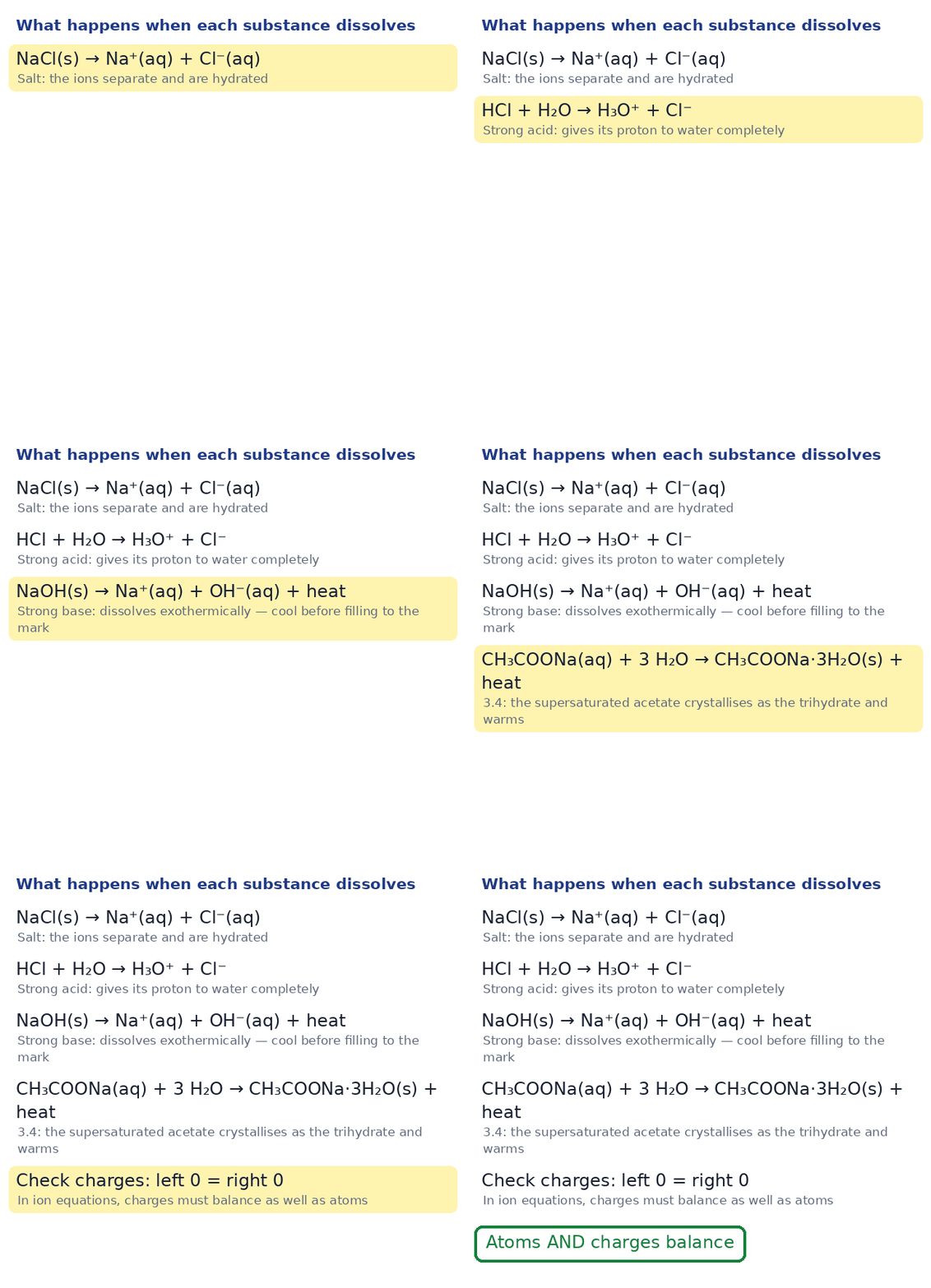
The equations in this lab.
- Dissolving NaCl: NaCl → Na⁺ + Cl⁻ (no reaction, only dissociation).
- HCl in water: HCl + H₂O → H₃O⁺ + Cl⁻.
- NaOH taking up CO₂ from the air: 2 NaOH + CO₂ → Na₂CO₃ + H₂O. This is why NaOH must be standardised.
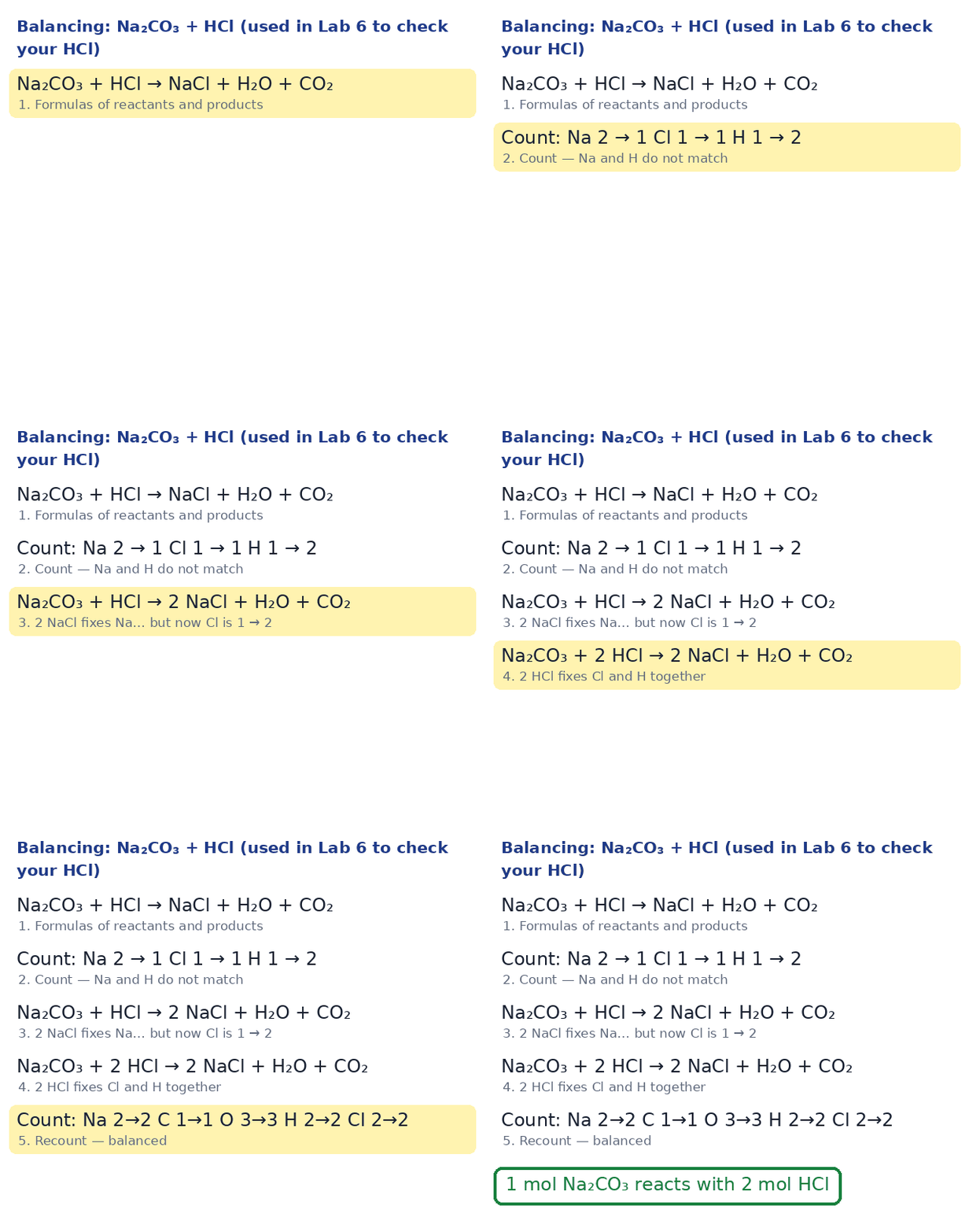
- Checking the HCl in Lab 6: Na₂CO₃ + 2 HCl → 2 NaCl + H₂O + CO₂↑. 1 mol of carbonate needs 2 mol of acid.
- Checking the NaOH in Lab 6: NaOH + HCl → NaCl + H₂O (1 : 1).
- Crystallising acetate in 3.4: CH₃COONa + 3 H₂O → CH₃COONa·3H₂O (sodium acetate trihydrate). Heat is given out.
Practice (answers below).
- NaOH + H₂SO₄ → Na₂SO₄ + H₂O
- Ca(OH)₂ + HCl → CaCl₂ + H₂O
- Al + HCl → AlCl₃ + H₂
- CaCO₃ + HCl → CaCl₂ + H₂O + CO₂
- KOH + H₃PO₄ → K₃PO₄ + H₂O
- Fe + O₂ → Fe₂O₃
Answers.
- 2 NaOH + H₂SO₄ → Na₂SO₄ + 2 H₂O
- Ca(OH)₂ + 2 HCl → CaCl₂ + 2 H₂O
- 2 Al + 6 HCl → 2 AlCl₃ + 3 H₂
- CaCO₃ + 2 HCl → CaCl₂ + H₂O + CO₂
- 3 KOH + H₃PO₄ → K₃PO₄ + 3 H₂O
- 4 Fe + 3 O₂ → 2 Fe₂O₃
Using a balanced equation in a calculation. The coefficients are mole ratios.
- Example: 0.106 g of Na₂CO₃ (M = 105.99 g/mol) is 0.00100 mol.
- From the equation, it needs 2 × 0.00100 = 0.00200 mol of HCl.
- If this took 19.6 cm³ of acid, c(HCl) = 0.00200 mol ÷ 0.0196 dm³ = 0.102 mol/dm³.
- This is exactly the calculation of Lab 6.
The report's conclusions
- 3.1: 10 g NaCl made 10% NaCl, density about 1.07 g/cm³ (hydrometer and weighing agree); molar concentration about 1.8 mol/dm³.
- 3.2: 8.6 cm³ of 36% HCl (11.6 M) diluted to 1 dm³ gives about 0.1 M HCl; acid added to water, in the hood.
- 3.3: 4.0 g NaOH in 1 dm³ gives about 0.1 M NaOH; approximate because NaOH is hygroscopic and absorbs CO₂, so it is standardised later.
- 3.4: the seeded and the rubbed tubes crystallised (with warming); the untouched tube stayed supersaturated. Seeds and scratches act as nucleation centres.
The class problem sheet
The exercise classes set a sheet of 39 concentration problems, and problem 2 was worked on the board in class. All 39 are on the practice page as printed, each with an answer box and a worked solution. What follows is the method, with the sheet's own problems as the examples.
Mass percentage
- Cp = m(solute) ÷ m(solution) × 100%, and the solution is the solute plus the solvent.
- On the board, problem 2: 1 g of a substance in 10 cm³ of water. Water: V = 10 cm³, d = 1 g/cm³, so m = 10 g. Cp = 1 ÷ (1 + 10) × 100% = 1/11 × 100% = 9.1%.
- The trap: 1 ÷ 10 = 10% divides by the water, not by the solution.
- A solvent given as a volume becomes a mass through its density, m = d × V. In problem 1, 150 cm³ of ethanol at 0.78 g/cm³ is 117 g, so Cp = 35 ÷ (35 + 117) × 100% = 23.0%.
- Evaporating to dryness leaves the solute: m(solute) = m(solution) × Cp. In problem 5, 30 g × 6% = 1.8 g of NaCl.
- A solution given as a volume: m(solution) = V × d first. In problem 7, 100 cm³ × 1.15 g/cm³ = 115 g, and 115 g × 17.1% = 19.7 g of KOH.
Molar concentration
- c = n ÷ V, in mol/dm³, with n = m ÷ M.
- The volume is the solution's. Problem 21 gives 150 cm³ of solution: 50 g ÷ 110.98 g/mol = 0.4505 mol, so c = 0.4505 ÷ 0.150 = 3.00 mol/dm³.
- Problem 22 dissolves the same 50 g in 150 cm³ of water. The solution is 200 g, and 200 g ÷ 1.23 g/cm³ = 162.6 cm³, so c = 0.4505 ÷ 0.1626 = 2.77 mol/dm³.
From percent to molar and back
- Take 1 dm³ of the solution: it weighs 1000 × d grams, and the solute is that mass × Cp. Hence c = 10 × Cp × d ÷ M, and Cp = c × M ÷ (10 × d), with d in g/cm³.
- Problem 29: 96% sulfuric acid, d = 1.84 g/cm³. c = 10 × 96 × 1.84 ÷ 98.08 = 18.0 mol/dm³.
- Problem 31: 5.5 M nitric acid, d = 1.18 g/cm³. Cp = 5.5 × 63.01 ÷ (10 × 1.18) = 29.4%.
Dilution
- C₁V₁ = C₂V₂. Problem 35, 500 mL of 0.25 M from 1 M acid: V₁ = 0.25 × 500 ÷ 1 = 125 mL of the acid with 375 mL of water. The sheet takes the volumes as additive; in the lab you make it up to the mark.
- From a percent stock, go step by step: the moles needed, their mass, the mass of stock that holds them, then its volume. In problem 37, 200 cm³ of 1 M acetic acid needs 0.2 mol = 12.0 g of acid. That is 12.4 g of the 96.5% acid, or 11.9 cm³ of it, made up to 200 cm³ with water.
Titration problems
- Problem 38: Na₂CO₃ + H₂SO₄ → Na₂SO₄ + H₂O + CO₂, one to one. 0.079 g ÷ 105.99 g/mol = 7.45 × 10⁻⁴ mol, in 17 cm³ of acid: c = 0.0438 mol/dm³.
- Problem 39: H₂SO₄ + 2NH₃ → (NH₄)₂SO₄. n(NH₃) = 2 × 0.1010 × 0.010 = 2.02 × 10⁻³ mol; c = 2.02 × 10⁻³ ÷ 0.0095 = 0.213 mol/dm³.
- Problem 36: pH 7 means the acid is exactly neutralised, and H₂SO₄ takes two NaOH: n(NaOH) = 2 × 0.01 × 0.200 = 0.004 mol, which is 40 cm³ of 0.1 M NaOH.